
What actually matters in month one
Beginners overthink programme choice and underthink consistency. In your first months almost any sensible plan works, because your body is reacting to a brand new stimulus. What does not work is turning up twice, getting sore, and disappearing for three weeks.
So the goals for month one are simple: train two or three times a week, learn six to eight basic movements, leave each session feeling you could have done a bit more, and write everything down.
Before your first session
- Get a check-up if needed. If you have a heart condition, high blood pressure, are pregnant, or have been inactive for years with health concerns, speak to a doctor first.
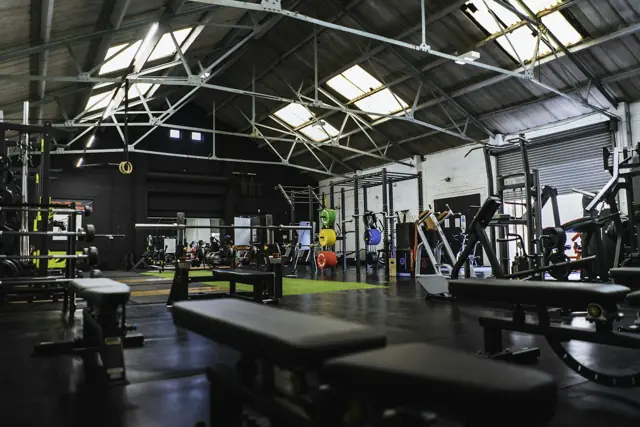
- Take the induction. Most gyms offer a free tour. Use it to learn where things are and how the machines adjust.
- Pack light. Comfortable clothes, flat-soled shoes, a water bottle, a towel, and your phone or a notebook for logging.
- Go at a quiet time. Mid-morning, early afternoon and late evening are usually calmer than 6 pm.
The eight movements to learn
Nearly every strength programme is built from a few movement patterns. Learn these and you can follow almost any plan.
| Pattern | Start with | Progress to |
|---|---|---|
| Squat | Goblet squat or leg press | Barbell back squat |
| Hinge | Dumbbell Romanian deadlift | Deadlift |
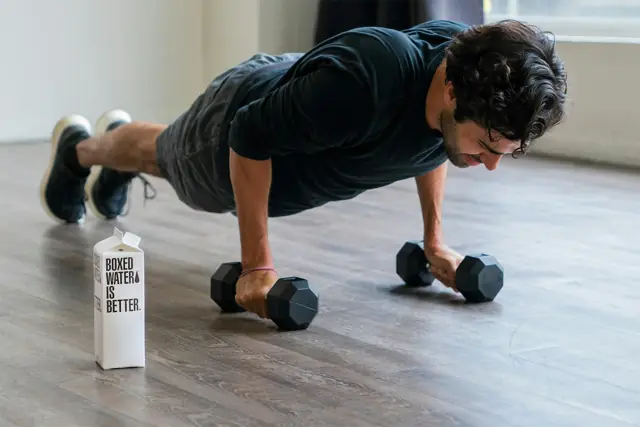
| Horizontal push | Push-up | Bench press |
| Vertical push | Dumbbell shoulder press | Overhead press |
| Horizontal pull | Seated cable row | Barbell row |
| Vertical pull | Lat pulldown | Pull-up |
| Single leg | Split squat | Walking lunge |
| Core | Plank | Longer planks, carries |
Machines and dumbbells are not "cheating". They are a sensible way to learn a movement and build strength before adding the skill demands of a barbell.
A simple first-month plan
Train three non-consecutive days a week, for example Monday, Wednesday and Friday. Alternate two full-body sessions.
| Workout A | Sets x reps | Workout B | Sets x reps |
|---|---|---|---|
| Goblet squat | 3 x 10 | Romanian deadlift (DB) | 3 x 10 |
| Dumbbell bench press | 3 x 10 | Dumbbell shoulder press | 3 x 10 |
| Lat pulldown | 3 x 10 | Seated cable row | 3 x 10 |
| Walking lunge | 2 x 10 each leg | Leg press | 2 x 12 |
| Plank | 3 x 20-30 s | Dumbbell curl | 2 x 12 |
Rest 60 to 120 seconds between sets. A session should take 45 to 60 minutes including a warm-up. When you are ready for something more structured, move on to our beginner full-body workout.
How heavy should you lift?
Choose a weight you can lift for the target reps with good form and about two or three reps left in the tank. The last couple of reps should feel challenging, but your technique should not change. If it breaks down, the weight is too heavy.
In week one, deliberately start light. You are learning, and very new lifters get sore easily. Each session, add a little: one more rep, or the next dumbbell up once you hit the top of the rep range on every set. That is progressive overload, and it is the engine of all progress.
Before your working sets, warm up properly:
- Five minutes on a bike, rower or brisk incline walk.
- A few dynamic moves: leg swings, arm circles, bodyweight squats, hip hinges.
- One or two light sets of your first exercise, at about 50% of your working weight.
That is enough. Long static stretching before lifting is not needed; save it for after training if you enjoy it.
Once you know your working weights, a quick estimate of your maximum can help you plan. Enter a recent set into the one-rep max calculator, but do not test true one-rep maxes in your first months; there is nothing to gain from it yet.
Gym etiquette nobody tells you
- Re-rack your weights and unload plates from bars when you finish.
- Wipe down benches and handles after use.
- Do not curl in the squat rack when it is busy.
- Ask "how many sets have you got left?" if you want to share equipment. Most people are happy to let you work in.
- Give people space in front of the mirror and do not walk directly in front of someone mid-set.
- Headphones in usually means "busy". Wait until they finish a set to ask a question.
And remember: almost nobody is watching you. Everyone else is thinking about their own workout.
Soreness, rest and food
Expect some muscle soreness (DOMS) a day or two after your first sessions. It fades as you adapt and is not a measure of a good workout. Sharp or joint pain is different: stop and get it checked if it persists.
Sleep seven to nine hours, and eat enough protein, roughly 1.6 g per kg of bodyweight, to recover. The protein calculator and TDEE calculator give you a starting point whether your goal is to lose fat or build muscle.
Week by week: what the month looks like
| Week | Focus | What to do |
|---|---|---|
| 1 | Learn | Light weights, 2 sets per exercise, practise every movement |
| 2 | Settle | 3 sets, find a weight that leaves 3 reps in reserve |
| 3 | Build | Add a rep or a small weight jump each session |
| 4 | Review | Compare your log with week 1, then pick your next programme |
Keep the same exercises all month. Switching every week feels fresh but stops you getting better at anything. Repetition is how a movement becomes skilful, and skill is what lets you load it safely later.
Five beginner mistakes to skip
- Copying an advanced routine. A six-day bodybuilding split built for someone with ten years of training is the wrong tool for week one.
- Ego lifting. Adding weight before your technique is stable is the fastest route to a tweaked back or shoulder.
- Skipping legs. Lower body exercises train your largest muscles and make everyday life easier. Do them.
- Doing only cardio for fat loss. Lifting protects muscle while you diet. Do both if fat loss is your goal.
- Changing everything after a bad week. One low-energy session means nothing. Look at a month of data.
Track it
Write down every exercise, weight, set and rep. A notes app is fine. Your log tells you what to beat next time, and after a month it becomes the best motivation you have: proof you are stronger than when you started.
Set a target of 12 sessions in your first month. Hitting that number matters more than anything you do inside them.
Frequently asked questions
How many days a week should a beginner go to the gym?
Two to three full-body sessions a week is ideal. It gives each muscle enough practice and enough recovery, and it is easy to sustain alongside work and family life.
Should beginners do cardio or weights first?
If your main goal is strength or muscle, lift first and do cardio afterwards or on separate days. A short cardio warm-up before lifting is fine.
How long until I see results from the gym?
Strength usually rises noticeably within two to four weeks as your nervous system learns the movements. Visible changes in muscle and body shape typically take eight to twelve weeks of consistent training and sensible eating.
Do I need a personal trainer as a beginner?
No, but a few sessions can be worth it to learn technique on the main lifts. Otherwise, start with machines and dumbbells, film your sets, and compare them to good demonstrations.
What should I eat before my first gym session?
A normal meal two to three hours before, or a light snack such as a banana or yogurt an hour before, is plenty. Avoid training on a completely empty stomach if it makes you feel light-headed.
General information for healthy adults, not medical advice. See our medical disclaimer.