
Legs exercise
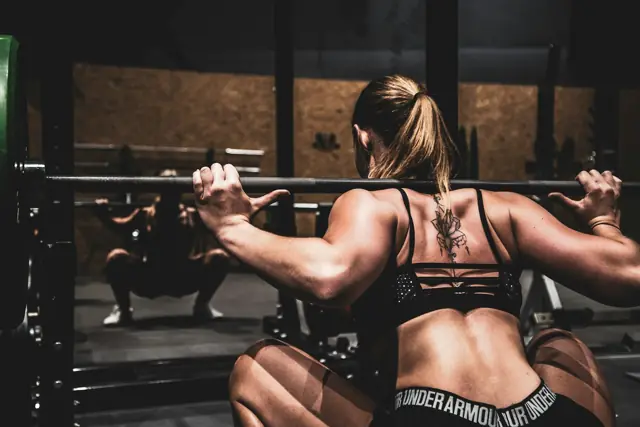
Barbell Back Squat
The back squat is the most direct way to build strong legs with a barbell. It loads the quads, glutes and adductors through a long range of motion and teaches you to brace your whole trunk under weight.
 By Khushi Gupta Reviewed October 2026
- Primary
- Legs
- Also works
- Glutes, Adductors, Lower back, Core
- Equipment
- Barbell, squat rack
- Level
- Intermediate
How to do it
- Set the bar in the rack at roughly mid-chest height, so you can unrack it with a slight knee bend rather than on your toes.
- Step under the bar and place it on your upper traps (high bar) or a few centimetres lower across the rear delts (low bar). Grip just outside your shoulders and pull your elbows down.
- Stand up to unrack, take two or three short steps back, and set your feet about shoulder width with toes turned out 15 to 30 degrees.
- Take a big breath into your belly, brace as if you are about to be punched, and hold that air.
- Break at the hips and knees together. Let your knees travel forward and out in line with your toes as you sit down between your heels.
- Descend until your hip crease is at or just below the top of your knee, keeping the bar over the middle of your foot.
- Drive up through the whole foot, pushing your knees out and leading with your chest, until you are standing tall. Breathe out at the top, re-brace, and repeat.
Coaching cues
- Bar over mid-foot the whole rep
- Knees follow the toes
- Brace before you descend, not during
- Chest and hips rise together
Common mistakes and fixes
Knees caving inward on the way up
Drop the load, cue "spread the floor" with your feet, and add glute work such as hip thrusts.
Hips shooting up first so the squat becomes a good morning
Lead with your upper back into the bar out of the hole and strengthen your quads with pauses or front squats.
Cutting depth as the weight gets heavier
Film from the side. If your hip crease stops above the knee, the weight is too heavy for full range.
Heels lifting off the floor
Widen your stance slightly, work on ankle mobility, or try weightlifting shoes with a raised heel.
Losing your breath halfway down
Take the breath and brace at the top, hold it for the whole rep, and only exhale once you are standing again.
Sets and reps
| Goal | Prescription |
|---|---|
| Strength | 3-5 sets of 3-6 reps, 3-5 minutes rest |
| Hypertrophy | 3-4 sets of 6-12 reps, 2-3 minutes rest |
| Beginner | 3 sets of 5 reps, adding 2.5 kg (5 lb) per session |
Pick a starting weight with the one rep max calculator, and load the bar with the plate calculator.
Variations
- Front squat Bar in front of the shoulders; more upright torso and more quad emphasis.
- Goblet squat A dumbbell or kettlebell held at the chest, the best way for beginners to learn the pattern.
- Box squat Sitting back to a box teaches depth and hip drive.
- Pause squat A two-second pause at the bottom builds strength out of the hole.
- Safety bar squat Easier on cranky shoulders and elbows.
Muscles worked
The squat is a quad exercise first. Your quadriceps straighten the knee and do most of the work out of the bottom position, which is why deep squats build the front of the thigh so well.
Your glutes and adductors (inner thigh) extend the hip, and they work hardest in the deepest part of the squat. The hamstrings act more as stabilisers than movers, because they lengthen at the hip as they shorten at the knee.
Your spinal erectors and abdominals hold your torso rigid so force goes into the bar rather than leaking through a bending spine. A heavy squat is a serious core exercise even though nothing about the trunk moves.
Why it is worth learning
Few lifts let you load the legs this heavily through this much range. That makes the squat an efficient builder of both strength and muscle, and it carries over to jumping, sprinting and getting off the floor as you age.
It is also easy to measure. Adding weight to the bar is the simplest form of progressive overload, and you can track your estimated max with the one rep max calculator.
Safety and who should modify it
Always squat in a rack with the safety arms set just below your bottom position, so a failed rep can be dumped onto the pins.
If you have knee, hip or back pain, start with a goblet squat or a leg press to a pain-free depth and progress from there. Anyone with a diagnosed spinal condition should get clearance from a physiotherapist or doctor before loading a bar on their back.
Frequently asked questions
How deep should I squat?
Aim for your hip crease to reach at least the top of your knee, which is called parallel. Going deeper is fine and trains the glutes more, as long as your lower back stays neutral and your heels stay down.
Is it bad for your knees to go past your toes?
No. Your knees need to travel forward for you to squat deep with an upright torso. What matters is that they track in line with your toes and do not cave inward.
Should I wear a belt?
A belt is not required, but it helps many lifters brace harder on heavy sets. Learn to brace without one first, then use it for work sets near your limit.
High bar or low bar?
High bar keeps you more upright and hits the quads harder. Low bar lets most people lift more weight by using more hip. Both are valid; pick the one that feels better and stick with it.
Plans that use the barbell back squat
Beginner · Strength
5x5 Strength Program
A 3-day 5x5 barbell program built on squats, presses, rows and deadlifts. A and B workouts, linear progression rules, and how to handle stalls.
 Beginner · General fitness
Beginner Full Body Workout
A 3-day full body gym plan for beginners. Learn the big lifts, add weight every week and build a solid base of strength and muscle in 12 weeks.
Related exercises
 Legs · Beginner
Leg Press
Leg press machine
 Legs · Intermediate
Romanian Deadlift
Barbell or dumbbells
 Legs · Beginner
Walking Lunge
Dumbbells or bodyweight