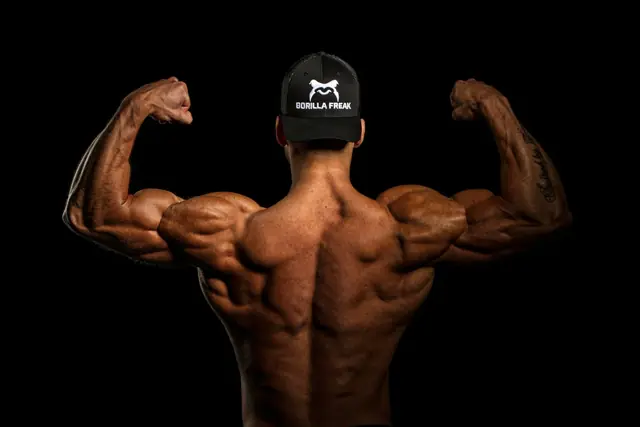
Why body fat beats the scale
Two people can weigh the same and look completely different because one carries more muscle and the other more fat. Body fat percentage separates the two, which makes it far more useful than weight or BMI for anyone who trains.
It also tells you whether a diet is working properly. If your weight drops but your body fat percentage barely moves, you may be losing muscle along with fat.
How the US Navy method works
The US Navy developed this method in the 1980s to assess personnel quickly without lab equipment. Researchers Hodgdon and Beckett compared circumference measurements against underwater weighing and built equations that predict body fat from them. It is still used by the US military today.
Men: BF% = 495 / (1.0324 - 0.19077 x log10(waist - neck) + 0.15456 x log10(height)) - 450
Women: BF% = 495 / (1.29579 - 0.35004 x log10(waist + hip - neck) + 0.22100 x log10(height)) - 450
All measurements are in centimetres. The calculator converts inches for you. From your body fat percentage it also works out fat mass (weight x BF%) and lean mass (weight minus fat mass).
How to measure correctly
The equations are very sensitive to waist size, so a sloppy measurement can move your result by several points. Use a flexible, non-stretch tape and measure in the morning before eating.
- Height: barefoot, back against a wall.
- Neck: just below the Adam's apple, tape angled slightly down toward the front.
- Waist (men): horizontally at the level of the navel, relaxed, at the end of a normal breath out.
- Waist (women): at the narrowest point, usually just above the navel.
- Hip (women): around the widest part of the buttocks, feet together.
Keep the tape snug but not pressing into the skin, and do not suck in. Take each measurement twice and use the average.
Reading your result
The calculator places you in one of the American Council on Exercise (ACE) categories:
| Category | Men | Women |
|---|---|---|
| Essential fat | 2 - 5% | 10 - 13% |
| Athletes | 6 - 13% | 14 - 20% |
| Fitness | 14 - 17% | 21 - 24% |
| Average | 18 - 24% | 25 - 31% |
| Obese | 25% and above | 32% and above |
Women naturally carry more essential fat, linked to hormonal and reproductive health, so their ranges sit higher. Staying near essential levels is not healthy long term for anyone; it is a stage-day condition for bodybuilders, not a goal.
How accurate is it?
Compared with lab methods, the Navy method typically lands within about 3 to 4 percentage points of the true value for most people. It tends to be less accurate for very lean, very muscular, or very heavy people, and for anyone whose fat is stored unusually.
Precision matters more than accuracy for tracking. If you measure the same way every time, the change over weeks is much more reliable than any single reading. Smart scales and bioimpedance devices are not clearly better, and they swing with hydration. Our guide to measuring body fat at home compares the options.
Measure every two to four weeks, not daily. Body fat changes slowly, and frequent checks mostly pick up measurement noise.
Worked example
A man 178 cm tall with a 38 cm neck and an 86 cm waist at the navel (70 in, 15 in and 33.9 in) weighs 80 kg (176 lb).
- Waist minus neck: 48 cm. log10(48) = 1.681
- log10(178) = 2.250
- Body fat: 495 / (1.0324 - 0.19077 x 1.681 + 0.15456 x 2.250) - 450 = about 17%
- Fat mass: 80 x 0.17 = 13.6 kg. Lean mass: 66.4 kg
That puts him at the top of the fitness category. If his waist drops by 4 cm over a cut while his neck stays the same, his estimate falls to about 14%, which shows how strongly the method responds to waist size.
That sensitivity is both its weakness and its strength. A careless measurement throws the result off, but a consistent one tracks real fat loss from the place most people store it.
What to do with your number
Use your lean mass to sharpen other calculations. The BMR calculator can use your body fat for the Katch-McArdle formula, and the FFMI calculator shows how muscular you are for your height.
If you want to lower body fat, set a modest deficit with the calorie calculator and read how to lose belly fat. If you are already lean and want to build, bulking vs cutting helps you plan the next phase.
Frequently asked questions
How accurate is the US Navy body fat method?
For most people it is within about 3-4 percentage points of lab methods. It is best used to track changes over time with consistent measurements.
Where should men measure their waist?
Horizontally at the navel, standing relaxed, at the end of a normal breath out. Do not pull the stomach in.
Why do women need a hip measurement?
Women tend to store more fat around the hips and thighs, so the women's equation includes hip size to account for it.
What is a good body fat percentage?
For general health and fitness, roughly 14-24% for men and 21-31% for women is common. Athletes often sit lower.
Is body fat percentage better than BMI?
For people who train, yes. BMI cannot tell muscle from fat, while body fat percentage shows your body composition directly.
References
- Hodgdon JA, Beckett MB. Prediction of percent body fat for U.S. Navy men and women from body circumferences and height. Naval Health Research Center, Reports 84-11 and 84-29, 1984
- American Council on Exercise. ACE Personal Trainer Manual. American Council on Exercise
- Heyward VH, Wagner DR. Applied Body Composition Assessment. 2nd ed. Human Kinetics; 2004
Results are estimates for healthy adults and are not medical advice. See our medical disclaimer.