
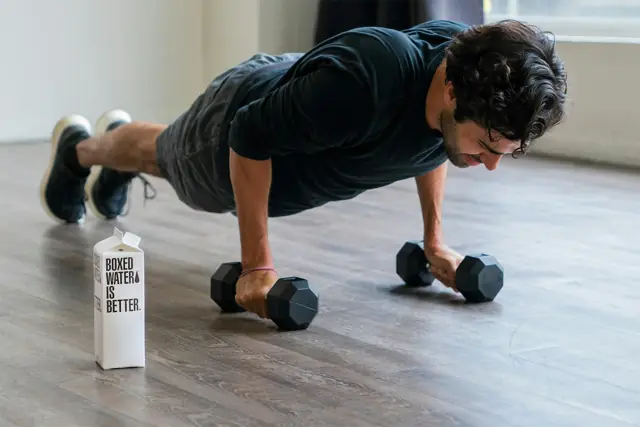
Legs exercise
Walking Lunge
The walking lunge is a single-leg exercise that builds the quads and glutes while challenging your balance. It exposes and fixes left to right differences that two-legged lifts can hide.
 By Khushi Gupta Reviewed October 2026
- Primary
- Legs
- Also works
- Glutes, Adductors, Hamstrings, Calves, Core
- Equipment
- Dumbbells or bodyweight
- Level
- Beginner
How to do it
- Stand tall holding a dumbbell in each hand at your sides, or with your hands on your hips for bodyweight lunges.
- Take a long step forward with one leg, landing heel first.
- Lower your back knee toward the floor until it almost touches, with your front shin roughly vertical.
- Keep your torso upright or leaning slightly forward and your front knee tracking over your toes.
- Push through your front foot to stand up and bring your back leg forward into the next step.
- Alternate legs as you walk, taking 8 to 12 steps per leg.
Coaching cues
- Long step, soft landing
- Back knee kisses the floor
- Front knee over the toes
- Tall chest
Common mistakes and fixes
Steps too short, so the front knee shoots forward
Lengthen your stride so both knees bend to about 90 degrees at the bottom.
Front knee caving inward
Push the knee out over your middle toes and slow down.
Walking on a tightrope
Keep your feet hip width apart side to side, as if on train tracks.
Slamming the back knee into the floor
Control the descent and stop just short of the floor.
Sets and reps
| Goal | Prescription |
|---|---|
| Strength | 3-4 sets of 6-8 steps per leg, heavy dumbbells |
| Hypertrophy | 3 sets of 10-12 steps per leg, 90 seconds rest |
| Beginner | 2-3 sets of 8 bodyweight steps per leg |
Pick a starting weight with the one rep max calculator, and load the bar with the plate calculator.
Variations
- Reverse lunge Stepping backward is easier on the knees.
- Bulgarian split squat Back foot on a bench for a deeper, harder single-leg squat.
- Barbell walking lunge Allows heavier loading for strong lifters.
- Stationary split squat Same pattern without walking, ideal for small spaces.
Muscles worked
The front leg's quadriceps and glutes do most of the work, with the adductors and hamstrings helping to stabilise the hip.
Balancing on a narrow base makes the glute medius and core work harder than in a squat, and the calves stabilise each landing.
Benefits
Single-leg training transfers well to running and sport, and it lets you work the legs hard with lighter weights. That makes lunges ideal for home workouts and for people whose backs do not like heavy barbells.
Walking lunges are also demanding on the heart and lungs, which is why they appear in many fat loss circuits.
Safety and who should modify it
If you have knee pain, switch to reverse lunges, shorten the range, or hold onto something for balance. Poor balance is common at first and improves quickly.
Frequently asked questions
Are lunges better than squats?
Neither is better. Squats allow heavier loads; lunges add balance and single-leg strength. Most programmes benefit from both.
Should I lean forward in a lunge?
A slight forward lean puts more work on the glutes; a very upright torso shifts it toward the quads. Both are fine if your back stays neutral.
How long should my steps be?
Long enough that both knees reach about 90 degrees at the bottom. For most adults that is roughly 60 to 90 cm (2 to 3 ft).
Plans that use the walking lunge
Beginner · General fitness
Home Dumbbell Workout
A 4-day home workout plan using only dumbbells and bodyweight. Upper and lower sessions, sets and reps, and how to keep progressing with limited weights.
 Beginner · Fat loss
Fat Loss Workout Plan
A 4-day fat loss workout plan that combines strength training with conditioning. Keep your muscle, burn more calories and know exactly what to do each day.
Related exercises
 Legs · Intermediate
Barbell Back Squat
Barbell, squat rack
 Glutes · Beginner
Hip Thrust
Barbell, bench, bar pad
 Legs · Beginner
Leg Press
Leg press machine
 Legs · Intermediate
Romanian Deadlift
Barbell or dumbbells