
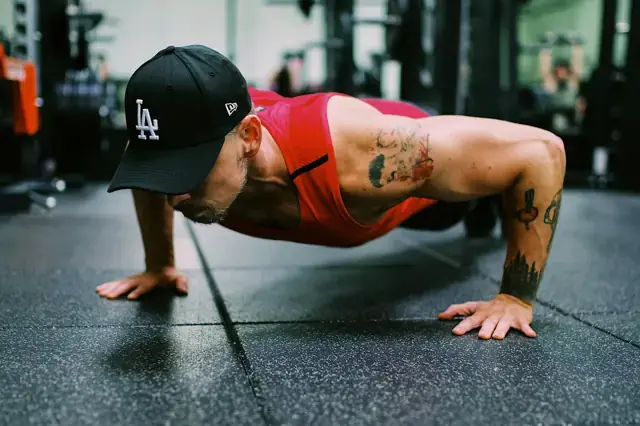
Chest exercise
Push-Up
The push-up is the most accessible upper body strength exercise there is. Done with good form, it trains the chest, shoulders, triceps and core together and can be scaled for almost anyone.
 By Khushi Gupta Reviewed October 2026
- Primary
- Chest
- Also works
- Triceps, Front delts, Core, Serratus anterior
- Equipment
- None (bodyweight)
- Level
- Beginner
How to do it
- Place your hands on the floor slightly wider than shoulder width, fingers pointing forward.
- Step your feet back so your body forms a straight line from head to heels. Squeeze your glutes and brace your abs.
- Lower your chest toward the floor by bending your elbows, keeping them at about 45 degrees from your body.
- Go down until your chest is a fist's width from the floor.
- Push the floor away to straighten your arms, keeping your body in one rigid line.
- At the top, push slightly further so your shoulder blades spread apart, then start the next rep.
Coaching cues
- Body like a plank
- Elbows at 45 degrees, not flared
- Chest leads, hips follow
- Push the floor away
Common mistakes and fixes
Sagging hips
Squeeze your glutes and brace your abs. If you still sag, elevate your hands on a bench.
Elbows flared straight out to the sides
Tuck them so your arms form an arrow shape with your body, not a T.
Tiny range of motion
Lower until your chest nearly touches the floor. Use an easier variation if you cannot reach full depth.
Head dropping forward
Keep your neck neutral and look at the floor slightly ahead of your hands.
Sets and reps
| Goal | Prescription |
|---|---|
| Strength | 4-5 sets of 5-10 reps of a hard variation |
| Hypertrophy | 3-4 sets of 10-25 reps, stopping 1-3 reps short of failure |
| Beginner | 3 sets of 5-10 incline or knee push-ups |
Pick a starting weight with the one rep max calculator, and load the bar with the plate calculator.
Variations
- Incline push-up Hands on a bench or wall to make it easier.
- Knee push-up A shorter lever for building toward full reps.
- Decline push-up Feet raised to emphasise the upper chest and shoulders.
- Diamond push-up Hands close together for more triceps.
- Deficit or weighted push-up Hands on blocks or a plate on your back to keep progressing.
Muscles worked
Like the bench press, the push-up is driven by the pectoralis major, front delts and triceps.
Unlike the bench, your shoulder blades are free to move, so the serratus anterior works too, and holding a rigid plank turns it into a core exercise.
Benefits
Push-ups need no equipment, so they fit into home workouts, travel days and warm-ups. Studies comparing push-ups and bench presses at similar effort have found similar muscle gains, so they are far more than a warm-up exercise.
They are also a simple fitness test. Tracking how many clean reps you can do is an easy way to see progress.
Safety and who should modify it
If your wrists hurt, use push-up handles or dumbbells to keep your wrists straight, or do them on your fists. Shoulder pain often improves when you tuck your elbows more.
Frequently asked questions
How many push-ups should I do a day?
There is no magic number. Two or three hard sets a few times a week is more effective than hundreds of sloppy reps every day.
Do push-ups build muscle?
Yes, especially for beginners and when taken close to failure. As you get stronger, harder variations or added weight keep them challenging.
Are knee push-ups worth doing?
Yes. They train the same muscles with less load and are a good bridge to full push-ups. Keep your body straight from knees to head.
Plans that use the push-up
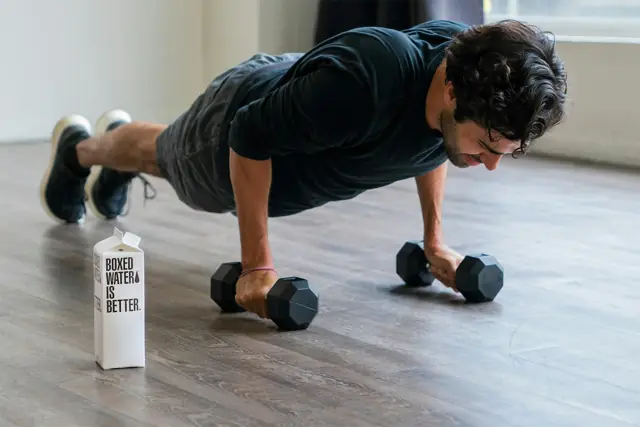 Beginner · General fitness
Home Dumbbell Workout
A 4-day home workout plan using only dumbbells and bodyweight. Upper and lower sessions, sets and reps, and how to keep progressing with limited weights.
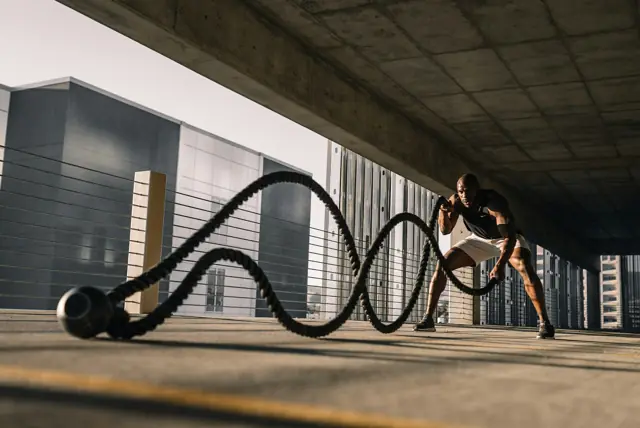 Beginner · Fat loss
Fat Loss Workout Plan
A 4-day fat loss workout plan that combines strength training with conditioning. Keep your muscle, burn more calories and know exactly what to do each day.
Related exercises
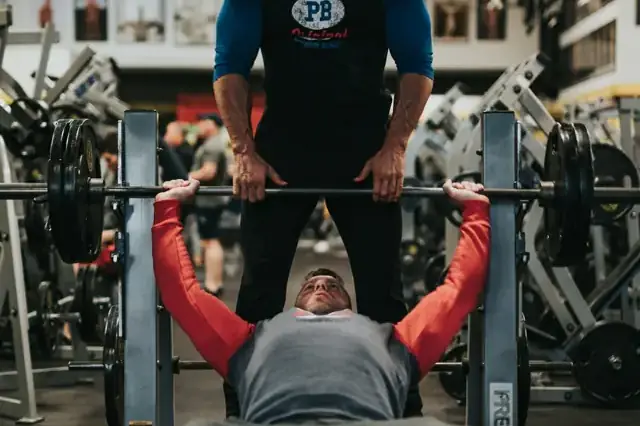 Chest · Beginner
Bench Press
Barbell, flat bench, rack
 Arms · Intermediate
Tricep Dip
Parallel bars or dip station
 Core · Beginner
Plank
None (bodyweight)
 Chest · Beginner
Incline Dumbbell Press
Dumbbells, adjustable bench