
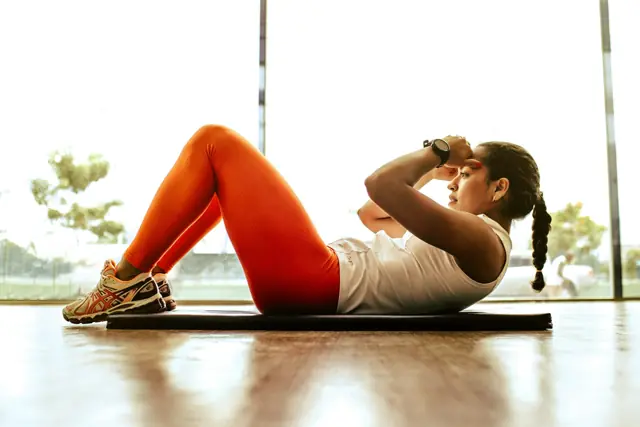
Core exercise
Plank
The plank trains your core to resist movement, which is what it does in most lifts and in daily life. It needs no equipment and is a solid foundation for stronger squats, deadlifts and presses.
 By Khushi Gupta Reviewed October 2026
- Primary
- Core
- Also works
- Glutes, Shoulders, Obliques
- Equipment
- None (bodyweight)
- Level
- Beginner
How to do it
- Kneel and place your forearms on the floor with elbows directly under your shoulders.
- Step your feet back so your body forms a straight line from head to heels, feet hip width apart.
- Squeeze your glutes hard and tuck your pelvis slightly so your lower back is flat, not arched.
- Pull your ribs down toward your hips and brace your abs.
- Push the floor away with your forearms so your upper back does not sag.
- Breathe steadily and hold for the target time, stopping when your hips start to drop.
Coaching cues
- Squeeze glutes, tuck pelvis
- Ribs down
- Push the floor away
- Quality over time
Common mistakes and fixes
Hips sagging toward the floor
Squeeze your glutes harder, and end the set once you cannot hold a straight line.
Hips piked high in the air
Lower them until you are straight from shoulders to heels.
Holding your breath
Breathe in short, controlled breaths while keeping your abs tight.
Chasing minutes of sloppy holding
Several hard 20 to 45 second holds beat one long, relaxed one.
Sets and reps
| Goal | Prescription |
|---|---|
| Strength | 3-4 hard holds of 10-20 seconds (RKC style) |
| Hypertrophy | 3 sets of 30-60 seconds or a harder variation |
| Beginner | 3 sets of 15-30 seconds with perfect alignment |
Pick a starting weight with the one rep max calculator, and load the bar with the plate calculator.
Variations
- Side plank Targets the obliques and the side of the hip.
- RKC plank Maximum tension for 10 to 20 seconds; much harder.
- Plank shoulder taps Adds anti-rotation challenge.
- Ab wheel rollout A dynamic progression for strong cores.
Muscles worked
The rectus abdominis and transverse abdominis stop your lower back from arching, the obliques stop rotation, and the glutes hold your pelvis in place. Your shoulders and serratus work to keep your upper back from sagging.
Benefits and limits
Planks teach the bracing that protects your spine during deadlifts and squats. They are a good starting point for beginners and people returning from time off.
They will not burn belly fat directly. Fat loss comes from an overall calorie deficit; see how to lose belly fat for what actually works.
Once you can hold a strict plank for 60 seconds, move to a harder variation instead of holding longer.
Safety and who should modify it
Planks are low risk. People with shoulder pain can do them from the hands with straight arms or against an incline. During and after pregnancy, check with your doctor or a pelvic health physiotherapist about appropriate core training.
Frequently asked questions
How long should I hold a plank?
For most people, 20 to 60 seconds of perfect form is enough. Beyond a minute, harder variations build more strength than longer holds.
Will planks give me abs?
They strengthen the abs, but visible abs depend mainly on body fat level, which is driven by diet.
Can I do planks every day?
Yes, they are low stress. Two to four sessions a week is plenty for most goals.
Plans that use the plank
 Beginner · General fitness
Beginner Full Body Workout
A 3-day full body gym plan for beginners. Learn the big lifts, add weight every week and build a solid base of strength and muscle in 12 weeks.
 Beginner · Fat loss
Fat Loss Workout Plan
A 4-day fat loss workout plan that combines strength training with conditioning. Keep your muscle, burn more calories and know exactly what to do each day.
Related exercises
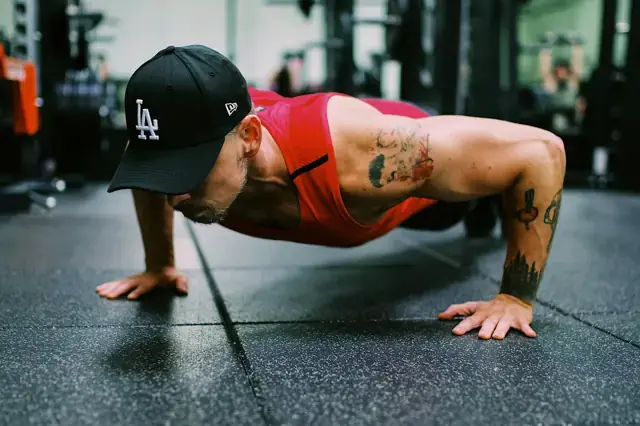 Chest · Beginner
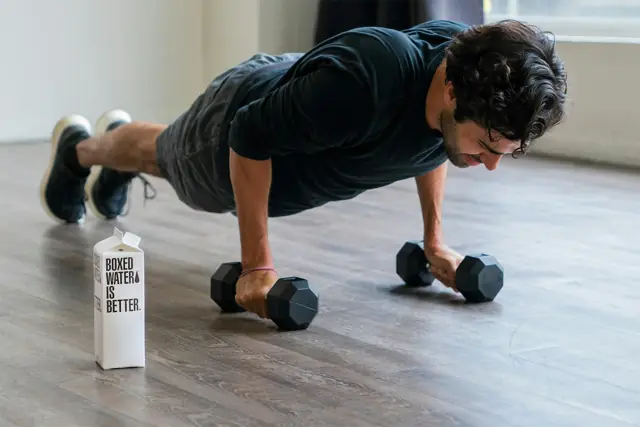
Push-Up
None (bodyweight)
 Back · Intermediate
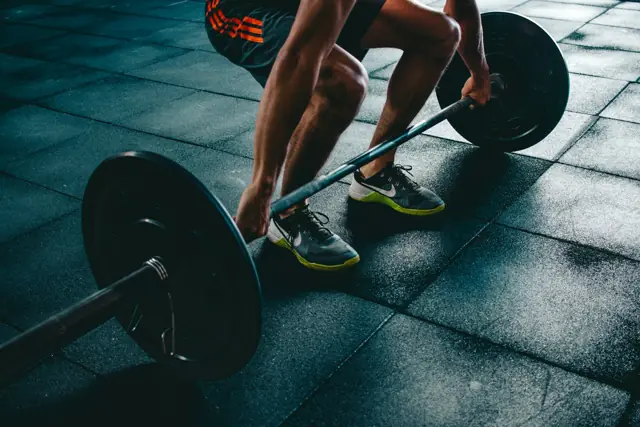
Deadlift
Barbell, plates
 Legs · Beginner
Walking Lunge
Dumbbells or bodyweight